
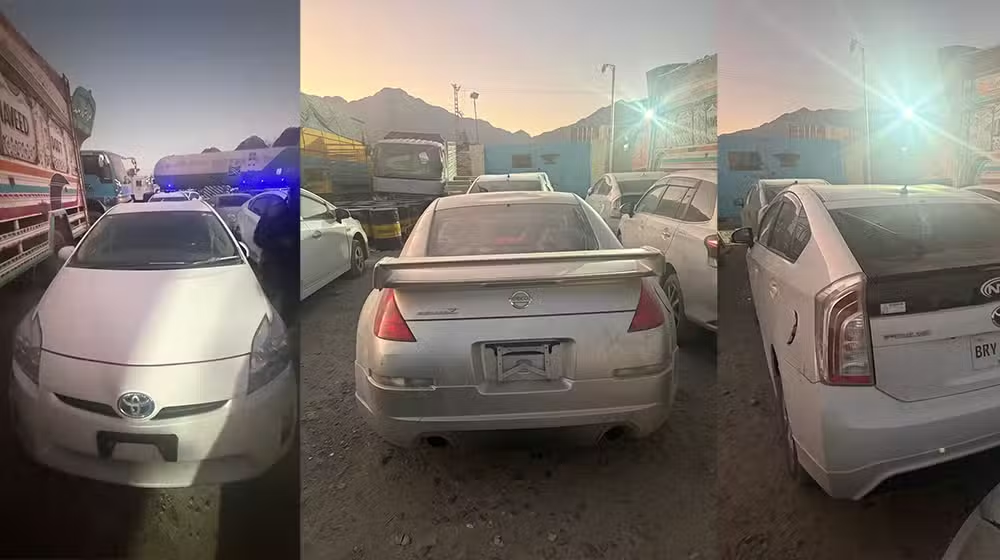
QUETTA: In one of the most significant enforcement actions carried out this month, Customs Enforcement Quetta has seized 11 non-duty-paid (NCP) vehicles worth an estimated Rs. 81 million during a large-scale anti-smuggling operation along the RCD Highway near Mastung. Officials said the operation was launched after intelligence inputs indicated the movement of high-value NCP vehicles through a key smuggling corridor used frequently for transporting contraband items into Balochistan and onward to other provinces.
According to Customs authorities, the operation was conducted on the basis of credible intelligence shared directly by the Chief Collector (Enforcement), Islamabad, highlighting the increasing coordination between regional and federal enforcement units to counter the escalating trend of vehicle smuggling. Officers from Customs Quetta set up a series of checkpoints and surveillance points along a vulnerable stretch of the highway, eventually intercepting multiple vehicles suspected of being moved without payment of import duties.
Upon inspection, officials confirmed that all 11 vehicles lacked proper documentation, customs clearance, and legal import papers, categorizing them as non-custom-paid under the Customs Act, 1969. The vehicles—some of them luxury SUVs and high-end off-road models—were immediately taken into custody and transported to a secure Customs facility for further verification and legal proceedings.
A senior officer involved in the raid, speaking on condition of anonymity, said the operation was executed after days of monitoring and covert observation of smuggling routes traditionally used by vehicle carriers. “These vehicles were being transported at night to avoid detection. Our teams were already on alert and moved swiftly once confirmation was received,” the official said, adding that smugglers had attempted to scatter and abandon the vehicles upon seeing Customs personnel.
Following the seizure, the Federal Board of Revenue (FBR) issued a statement reaffirming its resolve to intensify crackdowns against smuggling networks operating in and around Balochistan. The region has long served as a major smuggling transit point due to its geographical proximity to border crossings, extensive terrain, and vast, sparsely monitored road networks. Vehicles, fuel, tires, electronics, and high-value consumer items are among the most frequently trafficked goods.
“Smuggling is a significant threat to Pakistan’s economy, causing major losses to national revenue and undermining the local automotive and manufacturing sectors,” the FBR statement said. “The seizure of these vehicles reflects our continued commitment to eliminating illegal trade, protecting lawful commerce, and strengthening border enforcement.”
Related: Pakistan Customs Seizes Rs450 Million Worth of Crystal Meth Near Panjgur
Officials emphasized that the smuggling of non-custom-paid vehicles has long been a profitable underground business, often involving organized networks that transport vehicles from border regions into major cities where they are resold at prices significantly lower than legally imported models. The proliferation of such vehicles also affects the regulated automobile market, reduces tax revenue, and allows criminal syndicates to expand their operations.
Industry experts point out that NCP vehicles are often used in activities such as illegal mining, narcotics transport, and other illicit operations due to their unregistered status and difficulty in tracing ownership. Many of these vehicles enter Pakistan through irregular border points or via misdeclaration schemes that bypass duties.
Customs Enforcement Quetta has conducted several such operations this year, but officials described the latest seizure as among the “most financially significant” due to the high total valuation of the confiscated vehicles. Sources within the department added that further operations are expected in the coming weeks as part of a broader anti-smuggling campaign targeting multiple districts in Balochistan, including Chaman, Khuzdar, and Kharan.
As per procedure, the seized vehicles will remain in official custody until legal formalities are completed. If no lawful claim or documentation is presented, the vehicles may be auctioned following government policy, allowing the revenue generated to be deposited into the national exchequer.
Meanwhile, investigations have been initiated to identify the smugglers involved, the origin of the vehicles, and potential accomplices within the transportation chain. Authorities said that initial findings suggest a coordinated network operating between Quetta, Mastung, and the border belts, but further details cannot be disclosed until the investigation progresses.
The FBR leadership has reiterated that such raids will continue aggressively to curb illegal vehicle trafficking and ensure that the country’s revenue stream is protected. “We are committed to breaking the back of smuggling networks,” an official said. “No compromise will be made when it comes to safeguarding Pakistan’s economic interests.”


